
EV Charging Explained: What Every Canadian Should Know
Electric vehicles (EVs) are becoming a bigger part of Canada’s clean transportation future. But switching from a gas-powered car to an EV means learning a few new things , especially when it comes to charging.
Unlike gas stations where one fuel nozzle fits all, electric vehicles use different types of chargers depending on how fast you want to charge and where you are. Just like how gas vehicles use regular, premium, or diesel fuel, EVs need the right kind of charger to power up safely and efficiently.
Let’s break down the types of chargers, how they work, and why choosing the right charging option matters.
Level 1 Charging
Level 1 charging is the simplest and slowest way to charge an electric vehicle. It uses a regular 120-volt household outlet, the kind you already use to charge your phone or plug in a toaster.
You don’t need to buy special equipment or hire an electrician. Just plug in your car and it starts charging. However, since Level 1 chargers only add about 8 km of driving range per hour, it can take more than a full day to charge a completely empty battery.
This type of charging is best for:
- People who drive short distances daily
- Plug-in hybrid EVs with small batteries
- Drivers who have access to overnight parking and time
Why it matters: Level 1 charging is affordable and accessible, but it’s not practical for long commutes or full EVs with big batteries unless you drive very little each day.
- Uses regular household outlet (120V)
- Adds 8 km of range per hour
- Good for plug-in hybrids and light drivers
- No special installation needed
Level 2 Charging
Level 2 charging is much faster and more suitable for daily driving. It uses a 240-volt outlet, like what you use for a dryer or stove , and usually requires a dedicated charging unit (often installed in your garage or parking spot). Your home’s electrical service may need to be upgraded to accommodate this charging station.
Level 2 chargers can add between 30–50 km of range per hour, which is usually enough to fully charge most EVs overnight.
This makes Level 2 charging ideal for:
- Fully electric vehicles (BEVs)
- People with longer daily commutes
- Apartment buildings or shared parking areas
- Businesses that offer charging to customers or staff
Many public chargers across Canada are Level 2, making it the standard for home and public use.
Why it matters: If you’re planning to use an EV as your main car, Level 2 charging gives you the balance of speed and convenience you need.
- Uses 240V outlet (like your oven)
- Adds 30–50 km of range per hour
- Ideal for daily charging
- Found at home, offices, and public stations
Level 3 Charging
Level 3 charging, also called DC Fast Charging, is the fastest way to recharge an EV. These chargers are usually found along highways, at rest stops, and in major urban centers. They’re designed to get you back on the road quickly by adding 100–300+ km of range in just 20 to 30 minutes.
However, not all EVs can handle this type of charging. Many plug-in hybrids and some older EVs aren’t compatible with DC fast chargers. Also, fast charging can cost more than Level 1 or 2, but the convenience is often worth it when traveling.
Why it matters: If you drive long distances or want to take road trips in your EV, Level 3 charging is essential to keep your travel plans flexible and stress-free.
- Fastest charging available
- Adds 100–300 km of range in 20–30 minutes
- Best for road trips and commercial drivers
- Only works with certain EV models
NACS – The New Charging Standard
NACS, or the North American Charging Standard, is a newer type of plug originally created by Tesla but now adopted by many other automakers.
By switching to one common plug type, the charging process becomes much simpler , fewer adapters, better compatibility across brands, and easier access to existing networks.
Many new EVs being released in 2025 and beyond will come with NACS plugs, and adapters will be available for older models.
Why it matters: As NACS becomes the norm, it will be easier for Canadians to find and use chargers without worrying about compatibility.
- One universal plug for most EVs
- More convenient for drivers
- Adopted by major carmakers
- Reduces the need for multiple cable types
| Charging Type | Voltage/Power | Typical Charging Time | Common Locations | Best For |
| Level 1 | 120 V | 20-40 hrs | Home garages, driveways (regular wall outlet) | Overnight charging for short daily drives |
| Level 2 | 208-240 V | 4-8 hrs | Homes (with special installation), workplaces, public lots | Daily charging, full overnight top-ups |
| Level 3 (DC Fast Charge) | 480 V | 20-40 minutes | Highway rest stops, shopping centres, public charging hubs | Long road trips and quick top-ups |
| Hydrogen Fueling | 700 – bar pressure | 5 minutes | Select stations (BC, Quebec, Alberta) | Hydrogen fuel cell vehicles |
Why Picking the Right Charger (and EV) Matters
Choosing an EV is about more than colour, price, or how fast it goes. It’s about how it fits into your everyday life. Charging access and compatibility play a huge role in your satisfaction as an EV owner.
Ask yourself:
- Do I have a place to charge at home?
- How far do I drive each day?
- Will I take road trips?
- Can my building or workplace support EV charging?
Just like you wouldn’t buy a diesel truck without checking local fuel availability, you shouldn’t choose an EV without thinking about where and how you’ll charge it.
EV ownership is much easier when your charging setup matches your lifestyle. When the right charging method is available , whether it’s overnight at home or a fast charger on the highway , it makes the switch to electric simple, cost-effective, and enjoyable.
Charging Connectors 101
SAE J1772 (J Plug)
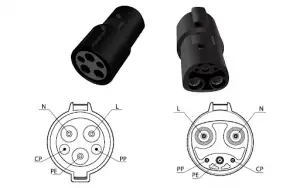
The SAE J1772 connector is the most common plug for Level 1 and Level 2 chargers in North America. It’s standard for almost every electric vehicle except Teslas — but even Teslas can use it with an adapter.
- Connector Type: J1772
- Levels: 1 & 2
- Compatibility: 100% of non-Tesla EVs
- Tesla: Compatible with adapter
- Used for: Home charging stations, public Level 2 chargers
Example: Your workplace or a grocery store charger likely uses this plug.
Level 3 Charging Connectors (DC Fast Charging)
CHAdeMO

CHAdeMO is one of the earlier DC fast-charging standards and is still found at many public fast-charging stations. However, it’s slowly being phased out in favour of newer options.
- Connector Type: CHAdeMO
- Level: 3
- Compatibility: Only some EV models (e.g. older Nissan Leafs)
- Tesla: Requires adapter
- Used for: Highway rest stops, older fast-charging networks
SAE Combo (CCS)

The SAE Combo, also known as CCS, is currently the most common standard for DC fast charging in North America for non-Tesla EVs.
- Connector Type: SAE Combo (CCS)
- Level: 3
- Compatibility: Most modern EVs
- Tesla: Not compatible (without adapter)
- Used for: Fast-charging hubs, highway charging corridors
Tesla-Specific Connectors
Tesla has its own proprietary connectors used in home and fast charging:
- Tesla HPWC (Wall Connector)
- Level: 2
- Compatibility: Tesla only
- Used for: Tesla home or destination charging
- Tesla Supercharger
- Level: 3
- Compatibility: Tesla only (until recently)
- Used for: Fast-charging on long trips
Good news: Tesla is opening its Supercharger network to other EVs through adapters and new plug standards (NACS).
The Rise of NACS (North American Charging Standard)

The NACS plug, developed by Tesla, is being adopted by major automakers like Ford, GM, and others by 2025. It’s smaller, more efficient, and may soon replace CCS as the go-to fast-charging connector in Canada and the U.S.
- Connector Type: NACS
- Level: 2 & 3 (depends on charger)
- Compatibility: Tesla now; other brands soon
- Used for: Home charging, Superchargers, and new public networks
Wall Outlets for Home Charging
You can also plug your EV charger into specific wall outlets, but each one works a bit differently:
| Wall Outlet | Voltage | Level | Where |
| NEMA 5-15 / 5-20 | 120V | Level 1 | Standard household plug (slow charging) |
| NEMA 14-50 | 240V | Level 2 | Common for RV (ideal for home EV charging) |
| NEMA 6-50 | 240V | Level 2 | Often used for high power appliances like dryers and stoves |
If you plan to install a Level 2 home charger, your electrician may recommend installing one of these.
Why This Matters
Just like gas cars need the right fuel ( regular, premium, or diesel) EVs need the right connector to charge. Here’s why it matters:
- Avoid Compatibility Issues: Not all fast chargers work with all vehicles.
- Save Time: Faster chargers need the right plug for your EV model.
- Plan Efficiently: Know what’s available on your route.
- Get More from Your EV: Using the right charger keeps your battery healthy.
Understanding charging connectors is the first step toward confident EV ownership. It helps you plan road trips, choose the right charger for your home, and make sense of the growing network of charging stations across Canada.
Stay tuned for our upcoming provincial infrastructure series, where we’ll explore what chargers are available in your region, and how to get the most out of them.