


Home Charging for EVs: Costs, Setup, and Regional Variations in Canada
Considering switching to an electric vehicle (EV)? One of the biggest perks of EV ownership is the ability to charge conveniently at home. But how exactly does home charging work, what are the costs involved, and what variations might you encounter depending on where you live in Canada? Let’s dive deeper into this essential aspect of electric vehicle ownership.
Why Consider Home Charging?
- Convenience: No more detouring to charge stations. Plug in when you sleep, drive in the morning.
- Lower Costs: Electricity is typically cheaper than gas. A full 400 km charge might cost just $8–$12.
- Reliability: Public stations go offline or get busy. Your charger stays in your garage.
Setting Up Your Home EV Charger
Step-by-Step Setup:
- Selecting Your Charger:
- Level 1 Charger: Usually included with the purchase of your EV, this charger plugs into any standard household outlet. It’s simple to use but charges slowly, providing about 8 km of range per hour of charging, ideal if you drive short distances daily.
- Level 2 Charger: A faster option, typically requiring professional installation and delivering about 30-50 km of range per hour of charging. It’s perfect for regular commuting and longer daily drives.
- Professional Installation:
- Always hire a certified electrician to install a dedicated electrical circuit for a Level 2 charger.
- Installation costs generally range between $500 and $2,500, influenced by factors like home wiring conditions and distance from the electrical panel to the charger location.
- Permits and Inspections:
- Some provinces or municipalities require permits and inspections to confirm the installation meets local electrical safety standards. Be sure to check local regulations before starting your project.
Breaking Down the Costs of Home Charging
Charger Costs:
- Level 1 Charger: Typically included with your EV purchase, so no additional cost.
- Level 2 Charger: Costs range from $600 to $1,200, depending on features such as Wi-Fi connectivity, charging speed, and brand reputation.
Installation Costs:
- Expect to pay between $500 and $2,500, depending on electrical upgrades, length of wiring needed, and local labor rates.
Electricity Costs:
- Charging at home generally costs $0.08 to $0.15 per kWh.
- A full battery charge, providing about 400 km of range, usually costs between $8 to $20, significantly cheaper than filling up with gasoline.
Regional Variations Across Canada
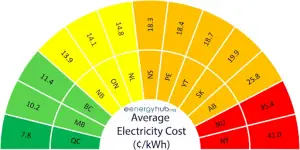
The cost and availability of charging incentives can vary significantly by province:
- Quebec:
- Lowest electricity rates in Canada (around $0.078 per kWh).
- Generous rebates for installing home EV chargers.
- British Columbia:
- Average electricity rates around $0.114 per kWh.
- Rebates available up to $350 for home charger installations through BC Hydro.
- Ontario:
- Average electricity rates approximately $0.141 per kWh.
- Some utilities offer specific incentives or off-peak charging discounts.
- Alberta:
- Electricity rates vary significantly by provider, averaging about $0.258 per kWh.
- Limited incentives for charger installations, though new programs are emerging.
- Atlantic Canada:
- Higher electricity rates, typically between $0.14 and $0.18 per kWh.
- Some emerging provincial incentive programs, particularly in Nova Scotia.
Government and Utility Incentives
Many federal, provincial, and municipal programs offer incentives to help reduce the cost of installing home EV chargers. The Zero Emission Vehicle Infrastructure Program (ZEVIP), for instance, supports Canadians in setting up charging infrastructure.
- Always check with local utilities and government websites for current, specific rebate programs and requirements in your area.
The following organizations have been granted funding to further distribute ZEVIP funds to Ultimate Recipients for smaller EV charging projects.
Only projects for which contribution agreements have been signed are listed below (may change without notice).
| Delivery Organizations: | Supporting EV charging for: | Contact Information: |
| Alberta Municipalities | public places, on-street, in multi-unit residential buildings, workplaces, and for light-duty vehicle fleets | EVCP@abmunis.ca |
| Eco-West Canada | public places, on-street, in multi-unit residential buildings, at workplaces, and for light-duty vehicle fleets | drobidoux@eco-ouest.com |
| Government of NWT | public places, on-street, in multi-unit residential buildings, workplaces, and for light-duty vehicle fleets | NWTEVIP@gov.nt.ca |
| Government of PEI | public places, on-street, in multi-unit residential buildings, workplaces, and for light-duty vehicle fleets | EVChargerRebate@gov.pe.ca |
| Government of Yukon | public places, on-street, in multi-unit residential buildings, workplaces, and for light-duty vehicle fleets | energy@yukon.ca |
| Green Economy Canada | public places, on-street, in multi-unit residential buildings, workplaces, and for light-duty vehicle fleets | EV Charger Incentive Program |
| Indigenous Clean Energy Social Enterprise | public places, in multifamily buildings, workplaces, and for light-duty vehicle fleets | jtait@indigenouscleanenergy.com |
| La grappe industrielle des vehicules electriques et intelligents (Propulsion Quebec) | public places, on-street, in multi-unit residential buildings, workplaces, and for light-duty vehicle fleets | sara.pellerin@propulsionquebec.com |
| Manitoba Motor Dealers Association | public places, on-street, in multifamily buildings, workplaces, and for light-duty vehicle fleets | LeadTheCharge@mmda.mb.ca |
| NB Power | public places, on-street, in multi-unit residential buildings, workplaces, and for light-duty vehicle fleets | pluginbranche@nbpower.com |
| Pollution Probe | public places, on-street, in multi-unit residential buildings, workplaces, and for light-duty vehicle fleets | Fern Tran, Director, EV Charging Incentive |
| Regional Tourism Organization (RT07) | Public places, multi-unit residential buildings, workplaces and light-duty fleets | info@rto7.ca |
| Ville de Montréal | public places, on-street, in multifamily buildings, workplaces, and for light-duty vehicle fleets | affaires@montreal.ca |
Maintenance and Longevity
A well-installed EV charger generally requires minimal maintenance. Regular checks to ensure connections remain secure and clean can prolong your charger’s life. Most chargers come with warranties ranging from 2 to 5 years, providing additional peace of mind.
Additional Considerations for Condo and Apartment Dwellers
If you live in an apartment or condo, setting up an EV charger at home can be harder than it is for people in single-family homes. This is mostly because parking spaces and electrical systems are shared in multifamily buildings. Many people also don’t have a dedicated parking spot, which makes installing a charger more complicated.
Even though about one-third of Canadians live in apartments or condos, only 12% of electric vehicle (EV) owners do. In cities like Vancouver, where nearly half the population lives in apartments, this gap is even bigger. As more people move into these types of homes, it’s important to make sure they also have access to home charging (Updated forecasts of vehicle charging needs, Dunsky Energy + Climate Advisors, 2024).
Some newer buildings are being built without parking at all to encourage other ways of getting around, like walking or transit. But no parking means no way to install a home charger. And right now, fewer than 50,000 EV-ready parking spaces exist in apartments and condos across Canada.
The good news is that change is possible. If we start requiring all new buildings to be EV ready by 2030, and retrofit older ones, we could see up to 4.7 million apartment and condo units with EV-ready parking by 2040. But if we don’t improve policies and programs, that number might only reach 81,000 by 2030 and barely grow after that (Dunsky, 2024).
Talking with your building manager and exploring shared charging solutions can help in the short term. However, bigger changes, like new building rules and retrofit programs, are needed to make EV charging fair and available for everyone, no matter where they live.
Simplifying EV Ownership
Charging your EV at home offers unparalleled convenience, cost savings, and ease of use. By understanding the initial costs, installation process, regional variations, and available incentives, Canadians can confidently transition to electric vehicles, enjoying seamless and sustainable mobility right from their own homes.
To learn more about home charging, whether you’re in a single-family home or a multi-unit building, visit ispiciwin.ca for helpful tools, policy updates, and real-life tips to support your switch to electric.